3I/ATLAS Shock: Unusual Chemical Mix Reveals Its Harmless Nature
The mysterious 3I/ATLAS comet has scientists divided: Is it alien technology or just a weird space rock?
By
The cosmos rarely sends a visitor quite like 3I/ATLAS. This interstellar comet, only the third ever confirmed to tear through our solar system from a distant star, has captivated and unnerved astronomers in equal measure.
While NASA assures the world that this magnificent piece of rock and ice poses no threat to Earth, one of the world's most provocative astrophysicists is raising a far more chilling question: Is this object truly natural, or is it a piece of ancient alien technology carrying a deadly chemical signature?
This extraordinary object was discovered on July 1, 2025, by the ATLAS system, a set of robotic telescopes watching the skies. Unlike most comets, 3I/ATLAS moves on a hyperbolic trajectory, meaning it is not bound to our Sun's orbit; it is merely passing through before continuing its billion-year journey into the void. It is moving at phenomenal speed—much faster than objects formed in our own neighbourhood—and will come no closer than about 270 million kilometres from Earth on December 19, 2025.
Yet, despite this safe distance, the drama surrounding the comet's true identity has intensified thanks to the bold claims of Harvard scientist Avi Loeb. Already famous for suggesting the first interstellar visitor, 'Oumuamua, might have been an alien probe, Loeb has spent the last few months cataloguing anomalies in 3I/ATLAS's behaviour. He argues that its behaviour is so peculiar, it defies conventional cometary science.
The Chemical Clues: Why 3I/ATLAS Is Carrying a 'WWI' Poison
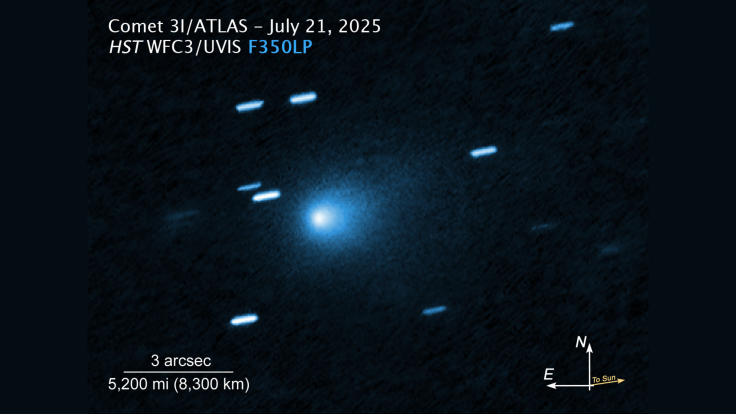
The core of the recent controversy lies in the chemical compounds detected within the comet's tail—or more accurately, its gaseous plume. Using highly sensitive instruments, including the ALMA observatory, scientists have identified methanol and, far more ominously, hydrogen cyanide in the gas cloud surrounding the nucleus.
Hydrogen cyanide is a chemical compound that, as the initial report highlighted, sounds 'rather intimidating' because it was once infamously used as a poison during the First World War.
While scientists are quick to stress that the presence of hydrogen cyanide in a comet is natural and common—it is a building block for organic molecules, after all—it feeds directly into the public anxiety fuelled by Professor Loeb's theories.
The comet will come no closer than 170 million miles from Earth, and scientists are keen to point out that this is an expected chemical signature for a comet, not a harbinger of chemical warfare from the stars.
Loeb's team has pointed out that the gas plume also contains an abundance of nickel—a metal typically associated with industrial alloys—and a nickel-to-cyanide ratio that is orders of magnitude larger than that of all known comets.
This kind of peculiar chemical composition has become the linchpin of Loeb's argument that 3I/ATLAS is not simply a cold chunk of cosmic debris but a 'technological artifact', perhaps the interstellar equivalent of the Voyager probes we launched decades ago.
Furthermore, 3I/ATLAS has displayed a structure known as a sunward jet or anti-tail that is not merely an optical illusion resulting from Earth's geometric perspective, unlike what is seen with most familiar comets.
Under normal conditions, comets generate a dust tail that curves gently and an ion tail that is pushed straight away from the Sun by the solar wind. The fact that the plume of 3I/ATLAS seems to be jetting towards the Sun is a significant abnormality.
The Trajectory Tangle: Is 3I/ATLAS an Interstellar Iceberg or an Alien Probe?
The object's unusual movement further complicates the picture. Loeb and his team have observed a collection of 'twelve anomalies' that, when considered together, make the case against a conventional comet increasingly compelling.
They highlight that its retrograde trajectory aligns with the ecliptic plane of the planets within five degrees—an exceptional coincidence with a probability of just 0.2 per cent for a randomly oriented object from deep space.
Its physical characteristics are equally perplexing. Initial brightness calculations suggested a diameter of approximately 20 kilometres, but later observations by the Hubble Space Telescope suggest the nucleus diameter is between 440 metres and 5.6 kilometres.
More recent data suggests it might be significantly more massive, which would mean it is not being pushed around by the 'rocket effect' of sublimating ices as much as a smaller object would be.
This discrepancy in mass and size, combined with the lack of expected water in its gas plume (it only contains 4% water by mass, a primary constituent of familiar comets), forces astronomers to confront uncomfortable possibilities.
Is 3I/ATLAS an unusually massive, volatile-rich iceberg formed in a profoundly cold region of space, or, as Loeb suggests, is it something more intentional?
For now, the official line from agencies like NASA and the European Space Agency (ESA) remains reassuring: the object poses 'no danger to our planet.' They stress that while it is undoubtedly a 'highly weird comet,' every piece of evidence is ultimately 'consistent with a natural, cometary origin.'
NASA continues to closely monitor the comet using the Hubble Telescope and the James Webb Telescope, hoping to gather enough data to definitively settle the debate.
The most immediate goal is to confirm whether the object is maintaining its structural integrity or showing signs of breaking up as it exits the inner solar system.
However, the ongoing debate serves as a powerful reminder that our scientific models must remain open to anomalies—because the universe, as 3I/ATLAS proves, still holds plenty of secrets left to uncover.
The cosmic drama surrounding 3I/ATLAS is far from over. While the public can breathe a sigh of relief knowing this interstellar visitor poses 'no danger to our planet'—as confirmed by NASA and ESA—the scientific mystery remains acute.
The peculiar mix of 'WWI' chemicals, the highly irregular sunward jet, and the highly improbable orbital path mean astronomers must continue to wrestle with Harvard's Avi Loeb's sensational theory: is this truly an 'iceberg' from another star, or a technologically engineered artefact?
The next phase of observations from the Hubble and Webb telescopes, as the object leaves the Sun's embrace, will be critical in deciding if our understanding of comets needs a massive rewrite, or if the cosmos just delivered proof of extraterrestrial technology to our doorstep.
Originally published on IBTimes UK
This article is copyrighted by IBTimes.co.uk, the business news leader


